Last Updated: June 2026
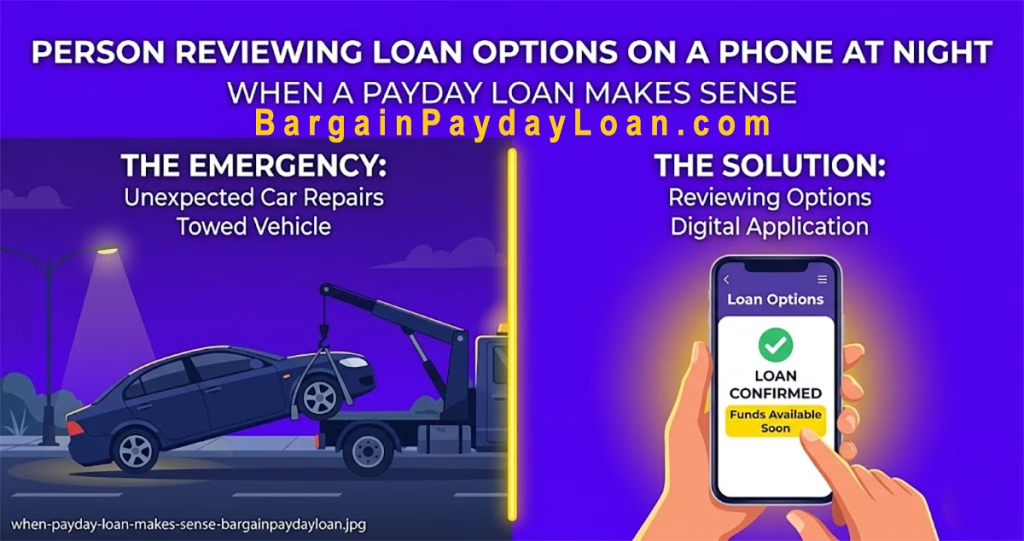
A payday loan is a short-term, small-dollar loan, typically $100 to $1,500, repaid on your next payday, usually within 2 to 4 weeks.
It’s the right tool when you have a specific, one-time cash gap that your next paycheck will close.
It’s the wrong tool when the shortfall is ongoing, the amount exceeds what one paycheck can realistically repay, or a cheaper option is genuinely available to you right now.
The fee runs $15 to $30 per $100 borrowed.
Whether that cost is worth it depends entirely on what you’re using it for.
That’s the answer. The rest of this page shows you how to tell which situation you’re actually in.
When a Payday Loan Is the Right Call
There are five situations where a payday loan is a legitimate tool.
1. You have a one-time, specific emergency.
The car needs a $400 repair. Without the car, you lose the job.
Without the job, the $400 problem becomes a $4,000 problem.
That’s a clear, bounded emergency.
The fee to fix it, about $80 to $100 on a $400 loan, is the cost of not losing the bigger thing.
That math works.
2. Your next paycheck will cover the full repayment.
This is the key question. A payday loan is designed to be repaid in one shot on your next payday, principal plus fee, out of your next deposit.
If you can look at your next paycheck and see the repayment coming out and still cover rent, groceries, and utilities, you’re in the right zone.
If you can’t, read the next section before you apply.
3. You’ve checked alternatives, and they’re not available.
Most people searching for a $255 or $500 same-day loan have already tried the obvious paths.
No family member can help. No credit card with an available balance.
No employer advance program.
No credit union emergency loan.
If you’ve checked and nothing is available fast enough, a payday loan fills a real gap, not replacing better options that exist.
4. The cost of not getting the cash is worse than the fee.
Utility shutoff.
Late rent with a fee.
A returned check that triggers an NSF cascade.
These costs are real.
A $300 loan that costs $75 in fees is a bargain compared to a $150 reconnection fee and a $35 NSF charge on every pending transaction.
Run the numbers.
The fee is the fee.
What happens without the loan is also a cost, often a bigger one.
5. You have income and a checking account.
Payday lenders focus on two things above your credit score:
- proof of regular income
- and an active checking account.
You don’t need perfect credit.
You need a job, a paycheck pattern, and a bank account that the lender can verify.
If you have those, you likely qualify.
Availability and approval are determined by the lender, not this site, but the qualifying bar is designed for people whose credit markets are underserved.
Availability, terms, and timing vary by state and lender. Not available in all states.
When a Payday Loan Is the Wrong Call
Here’s the part most payday loan sites won’t write.
1. The problem is ongoing, not one-time.
If you’re $500 short every month, not because of an emergency but because income doesn’t cover expenses, a payday loan doesn’t fix that. It adds a fee to the shortfall next month. Then the month after.
A payday loan is a bridge. If the bridge doesn’t lead anywhere, you’re still in the water.
2. The amount you need is more than one paycheck can cover.
Borrow $800 on a two-week loan. Repayment is roughly $1,000 on payday ($800 + $200 in fees). If your take-home is $1,100 and your fixed expenses don’t change, you’re left with $100 for two weeks, which may put you right back in the same hole.
This is where rollovers start. Rollovers are not a strategy. The cost compounds every cycle.
3. You have an alternative you haven’t tried.
A credit card cash advance runs high, but usually lower than a payday loan fee over the same period.
A personal loan from an online lender may take 1–2 days, but costs less over time.
Some credit unions offer emergency loans to members at dramatically lower rates.
If a cheaper option is genuinely available to you, use it first. This site exists to serve borrowers who don’t have those options, not to be the default when better paths are open.
4. You’re already in a payday loan.
If you have an open payday loan and you’re looking for a second one to cover the first, stop.
That is a cycle, not a solution.
Rolling over or stacking payday loans turns a $400 problem into a $1,200 problem inside 90 days.
If you’re in that situation, resources are available. The CFPB borrower resource is a start. Some state programs offer payday loan exit options.
5. The money is for something you can wait on.
Not every expense is an emergency. If the purchase can be delayed by 30 days without real harm, skip the loan and save toward it.
A payday loan is priced for urgency. Don’t pay urgency pricing for something that isn’t urgent.
The Cost Math: What “Short-Term” Actually Means
People searching for a “$500 payday loan same day” are often focused on access speed. The cost comes second. Here’s how to read it honestly before you apply.
On a $500 loan:
- Fee at $25 per $100 borrowed: $125
- Total repayment on payday: $625
- Timeframe: 14 days
If $625 comes out of your next deposit and you can still cover your bills, the $125 is the cost of access.
It’s a high fee.
It’s also a clear fee.
You’ll see the exact dollar amount and due date before you accept.
Not buried.
Not revealed after.
That clarity is the deal.
On a $255 loan (a common amount in California, where state law caps the loan):
- Fee at $17.65 per $100 (California cap): roughly $45
- Total repayment: $300
- Timeframe: 14 days
Same math. Smaller numbers.
APR on these loans is high by design.
Payday loans are short-duration products, and APR annualizes a fee that was never meant to be paid over a year.
APR varies by lender, loan amount, and state law. See your loan agreement for full terms.
What matters more than APR: can your next paycheck absorb the repayment without breaking something else?
If yes, you have a clear decision. If no, see the “wrong call” section above.
| Your Situation | USE IT Payday Loan May Help | SKIP IT Look for Another Option |
|---|---|---|
| Type of problem | One-time emergency — car repair, utility shutoff, medical copay | Recurring monthly shortfall — income doesn't cover normal expenses |
| Repayment reality | Next paycheck covers the full repayment and your regular bills | You'll need to roll over or borrow again to cover next month |
| Alternatives available | No affordable alternative is available fast enough | A credit card, personal loan, or family loan is genuinely accessible |
| Loan amount needed | $100–$800 — an amount one paycheck can absorb | $1,500+ — or more than 50% of your monthly take-home |
| Current loan status | No open payday loans right now | Already have an open payday loan or are in a rollover cycle |
| Urgency level | Real consequence if the cash gap isn't closed today or this week | The purchase can wait 30+ days without meaningful harm |
How Payday Loans Work Online
If you’ve been searching for “payday loan stores near me” or “payday loan lenders near me,” it’s worth knowing that most payday lending happens online now.
No storefront required.
The process:
- Submit a short application with your income, banking info, and ID
- Lenders review your application — approval is typically based on income and banking history, not a traditional credit score
- If approved, you review the exact fee, loan amount, and due date before you accept — nothing hidden
- Funds are deposited into your checking account, in many cases, on the same business day
- On your due date, the repayment pulls automatically from the same account
That’s it.
You don’t drive anywhere.
You don’t stand in line.
For borrowers in most states, the whole process is handled over the phone.
For a deeper walkthrough, see our guide: How Online Payday Loans Work: A Simple, Secure Guide.
Availability, terms, and timing vary by state and lender. Not available in all states.
Frequently Asked Questions
Is a payday loan a good idea if I have bad credit? It can be, depending on your situation. Most payday lenders focus on income and banking history rather than your credit score — a traditional hard credit pull is not always required, though this varies by lender. Bad credit doesn’t automatically disqualify you. The more important question is whether your next paycheck will cover the full repayment. If yes, bad credit is unlikely to be the obstacle.
What happens if I can’t repay on the due date? Contact the lender before the due date, not after. Most lenders have options. Some states require lenders to offer a repayment plan if you ask before the loan comes due. Rolling over the loan, extending it for another fee cycle, is expensive and compounds the problem. Be honest about what you can repay before you borrow, so you don’t end up in that position. For more on this topic, see the CFPB’s payday loan resource.
How much can I borrow with a payday loan? Typically $100 to $1,500, but state law caps vary. California limits payday loans to $300 (with a max fee of $45). Some states allow up to $1,000 or more. The lender determines the actual offer based on your income, banking history, and state. BargainPaydayLoan.com is not a lender and cannot guarantee a specific amount; the lender makes that call.
Can I get a payday loan if I’m self-employed or a gig worker? Yes, in many cases. Payday lenders typically require verification of consistent income and a checking account with regular deposits. If you can show that through bank statements or tax documents, self-employment income may qualify. This varies by lender.
Is there a credit check for a payday loan? Many lenders on our network focus on income and banking history rather than your traditional credit score. A hard pull on your credit report is not always required — but this varies by lender. You’ll see the exact terms before you accept any loan.
What’s the difference between a payday loan and a personal loan? A payday loan is designed for small amounts ($100–$1,500) with a very short repayment window (your next payday, typically 2–4 weeks). A personal loan is usually larger, with a longer repayment term and a lower fee structure, but qualification typically requires better credit and takes more time to process. If you need money today and don’t qualify for a personal loan, a payday loan may be the available option. If you have the time and the credit, a personal loan is usually cheaper.
Payday Loan Today: Where to Apply Online
What to check before you apply — lender options, requirements, and what a same-day process actually looks like.
Best Payday Loan Advance Options for 2026
Top options for emergency cash advances, reviewed for access speed, cost, and qualification ease.
Payday Loans: Online Options That May Be Easier to Qualify For
If banks have said no, here's where the bar is lower and why.
Online Payday Loans Same Day Deposit
A realistic guide to what "same day" actually means and how to give yourself the best shot at it.
Same Day Payday Loan — Get Cash Options Fast
When you need it today, here are the options and the honest timelines.
Online Payday Loans — Apply In Minutes
Apply in minutes and make an informed decision. Here's what the process looks like end to end.
Quick, Convenient, Fast Payday Loans Online
Speed matters when the problem is urgent. Here's what fast actually looks like in practice.
How Online Payday Loans Work
The step-by-step process from application to funding to repayment, in plain English.
Honest Payday Help When Cash Is Tight
No runaround. No fine print buried in paragraph five. Just what you need to know.
Payday Loan: Fastest Approval — Bad Credit Welcome
Bad credit isn't a dealbreaker for most payday lenders. Here's what actually matters.
Fast Online Payday Loans in Texas
Texas-specific guide to online payday loans — process, requirements, and what the state allows.
Fast, Easy Car Title Loans in the USA
If you own your car, a title loan is another short-term option worth understanding.